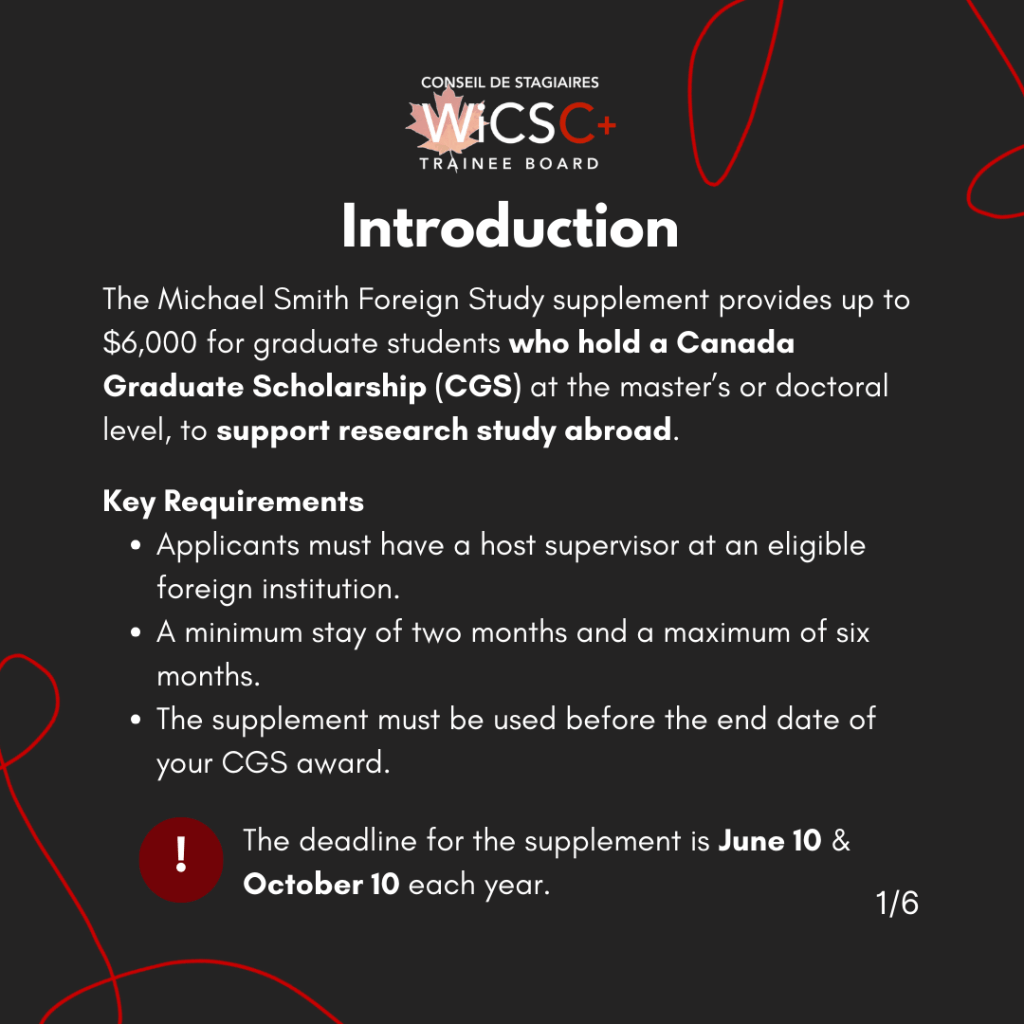
Canada Graduate Scholarship – Michael Smith Foreign Study Supplement (CGS-MSFSS; 2-6 months, up to CAD $6000)



Contributors:
- Writer: Megan Kelly
- Editor: Madeline Wood Alexander, Fraulein Retanal
- Translator: Elena Bakker, Diya Kamineni
- Visuals: Tamanna
Official information from NSERC regarding the supplement and application procedures is available at: https://www.nserc-crsng.gc.ca/Students-Etudiants/PG-CS/CGSForeignStudy-BESCEtudeEtranger_eng.asp
Award holder’s guide by NSERC: https://www.nserc-crsng.gc.ca/Students-Etudiants/Guides-Guides/CGSMSFSSRegs-BESCSEEMSRegs_eng.asp
NSERC Email: schol@nserc-crsng.gc.ca
CIHR Email: CGSMSFSS-SEEMSBESC@cihr-irsc.gc.ca
SSHRC Email: fellowships@sshrc-crsh.gc.ca
The following article is not intended as a substitute for official NSERC or Tri-agency documentation regarding the MSFSS. Instead, it is meant to be a supplementary guide for graduate students interested in applying for the MSFSS, offering insights and tips to successfully plan and complete a visiting study term. The guide emphasizes Canadian students as visiting scholars in the USA but may be helpful for other arrangements including other international destinations and other short-term study opportunities beyond those funded by the MSFSS.
Part 1: Finding a Potential Host Supervisor
If you have not arranged a host-supervisor yet, and are unsure exactly how to begin, here are some considerations:
Number 1: Host type and your academic/career goals
Eligible host institutions include foreign universities, inter-university research centres, international or national research institutes or laboratories, or other institutions with a research mandate.
Consider the alignment with your career goals, whether they lie within Industry/Non-profit, Academia, or other fields. If you are undecided, you can take this as a chance to explore a different field!
Number 2: Resources/Training
A few questions to ask yourself:
- What sort of resources do you need to conduct your research versus what can they offer you?
- What can you offer their research program in terms of unique skills and expertise?
- What new skills and experiences are you hoping you to gain from your visit?
Number 3: Your available network
When considering potential host supervisors, a good place to start is to think about colleagues and collaborators in your own (or your supervisor’s) professional network.
A few questions to ask yourself:
- Have others in your lab or in your department collaborated with them before?
- Are you familiar with their research?
- Are they familiar with your research?
The answers to the above questions don’t all have to be “yes” for it to be a good match and a successful study trip but the more “yes” responses you have to the above questions, the more likely the arrangement will seem appropriate to the host PI.
When in doubt, open the conversation up to your home supervisor and/or other colleagues and mentors you think might be able to advise on potential supervisors — chances are, they can pull from the experiences of previous graduate students and/or know relevant information from their own networks.
Number 4: Compatibility
How do your interests and work styles seem to align or complement each other? This can be hard to determine ahead of time unless you already know the host supervisor or know someone who does.
If possible, try to reach out to current or former graduate students in the potential host supervisor’s lab. A few questions you can ask them are:
- What is the lab culture like? Is it competitive or collaborative?
- How responsive is the supervisor to feedback and suggestions from students?
- How flexible is the supervisor with regards to work hours and personal commitments?
- Are there any particular challenges or drawbacks associated with working under this supervisor that I should be aware of?
Ready to take the next step after spotting your potential PI? It’s time to make that connection! Check out Part 2 of our Michael G Smith Series for valuable tips and tricks on how to reach out to a potential host supervisor.
Bourse d’études supérieures du Canada – Suppléments pour études à l’étranger Michael-Smith (BESC-SEEMS ; 2-6 mois, à hauteur de 6000 $ CA)






Contributrice :
- Écrivaine : Megan Kelly
- Révision: Madeline Wood Alexander, Fraulein Retanal
- Traductrice : Elena Bakker
- Visuels : Tamanna
Les informations officielles du CRSNG concernant le supplément et les procédures de candidature sont disponibles à l’adresse suivante : https://www.nserc-crsng.gc.ca/Students-Etudiants/PG-CS/CGSForeignStudy-BESCEtudeEtranger_fra.asp
Guide à l’intention des titulaires par CRSNG : https://www.nserc-crsng.gc.ca/Students-Etudiants/Guides-Guides/CGSMSFSSRegs-BESCSEEMSRegs_fra.asp
Adresse courriel du CRSNG : schol@nserc-crsng.gc.ca
Adresse courriel des IRSC : CGSMSFSS-SEEMSBESC@cihr-irsc.gc.ca
Adresse courriel du CRSH : fellowships@sshrc-crsh.gc.ca
L’article suivant ne vise pas à remplacer la documentation officielle du CRSNG ou des trois organismes concernant les SEEMS. Il s’agit plutôt d’un guide supplémentaire pour des étudiants diplômés qui désirent postuler pour les SEEMS, offrant des conseils pour bien planifier et terminer un trimestre d’études à l’étranger. Ce guide met l’accent sur les étudiants canadiens en tant qu’étudiants invités aux États-Unis, mais il pourrait être utile pour d’autres arrangements, y compris d’autres destinations internationales et d’autres opportunités d’études à court terme au-delà de celles financées par les SEEMS.
Partie 1 : Trouver un superviseur d’accueil potentiel
Si vous n’avez toujours pas trouvé un superviseur d’accueil et vous ne savez pas trop comment y commencer, voici quelques éléments à considérer :
Numéro 1. Type d’hôte et vos objectifs académiques/de carrière
Les institutions d’accueil éligibles incluent des universités étrangères, des centres de recherche interuniversitaires, des instituts de recherche ou des laboratoires nationaux ou internationaux, ou d’autres institutions ayant un mandat de recherche.
Considérez en quoi ces institutions concordent avec vos objectifs de carrière, qu’ils se situent dans le secteur industriel ou à but non lucratif, dans le monde académique, ou ailleurs. Si vous êtes indécis, vous pouvez profiter de cette opportunité pour explorer un domaine différent !
Numéro 2. Ressources/formation
Quelques questions à se poser :
- De quelles ressources avez-vous besoin pour mener votre recherche et que peuvent-ils vous offrir ?
- Quelles compétences et expertises uniques pouvez-vous offrir à leur programme de recherche ?
- Quelles compétences et expériences espérez-vous gagner à partir de votre visite ?
Numéro 3. Vos connexions disponibles
Lorsque vous considérez des superviseurs d’accueil potentiels, il est utile de commencer en pensant aux collègues et aux collaborateurs dans votre réseau professionnel (ou celui de votre superviseur).
Quelques questions à se poser :
- Est-ce que d’autres personnes dans votre labo ou votre département ont déjà collaboré avec eux ?
- Connaissez-vous bien leur recherche ?
- Connaissent-ils bien votre recherche ?
Il n’est pas nécessaire de répondre par l’affirmative à toutes les questions ci-dessous pour que ce soit une bonne correspondance et que le voyage d’étude soit réussi, mais plus vous répondez par l’affirmative à ces questions, plus il est probable que l’arrangement semblera approprié au chercheur principal d’accueil.
En cas de doute, ouvrez la conversation à votre superviseur local et/ou à d’autres collègues et mentors que vous croyez être capable de vous conseiller sur des superviseurs potentiels. Il est probable qu’ils pourront se baser sur les expériences d’anciens étudiants diplômés et/ou qu’ils auront des informations pertinentes grâce à leurs propres réseaux.
Numéro 4. Compatibilité
Comment vos intérêts et vos styles de travail s’alignent ou se complètent-ils ? Ceci peut être difficile à déterminer en avance, à moins que vous connaissiez déjà le superviseur d’accueil ou quelqu’un d’autre qui le connaît.
Si possible, essayez de contacter des étudiants diplômés actuels ou anciens du laboratoire du superviseur potentiel. Voici quelques questions que vous pourriez leur poser :
- Quelle est la culture du laboratoire ? Est-elle compétitive ou collaborative ?
- À quel point le superviseur est-il sensible à la rétroaction et aux suggestions des étudiants ?
- À quel point le superviseur est-il flexible en ce qui concerne les heures de travail et les obligations personnelles ?
- Y a-t-il des défis ou désavantages particuliers liés au travail sous la direction de ce superviseur ?
Vous êtes prêt à passer à la prochaine étape après avoir trouvé votre superviseur potentiel ? Il est temps d’établir un contact ! Consultez la deuxième partie de notre série Michael G Smith pour obtenir des astuces et des conseils utiles sur comment entrer en contact avec un superviseur d’accueil potentiel.
 WiCSC
WiCSC 