

Contributors:
- Writer: Megan Kelly
- Editor: Madeline Wood Alexander, Fraulein Retanal
- Translator: Elena Bakker, Diya Kamineni
- Visuals: Tamanna
Official information from NSERC regarding the supplement and application procedures is available at: https://www.nserc-crsng.gc.ca/Students-Etudiants/PG-CS/CGSForeignStudy-BESCEtudeEtranger_eng.asp
Award holder’s guide by NSERC: https://www.nserc-crsng.gc.ca/Students-Etudiants/Guides-Guides/CGSMSFSSRegs-BESCSEEMSRegs_eng.asp
NSERC Email: schol@nserc-crsng.gc.ca
CIHR Email: CGSMSFSS-SEEMSBESC@cihr-irsc.gc.ca
SSHRC Email: fellowships@sshrc-crsh.gc.ca
The following article is not intended as a substitute for official NSERC or Tri-agency documentation regarding the MSFSS. Instead, it is meant to be a supplementary guide for graduate students interested in applying for the MSFSS, offering insights and tips to successfully plan and complete a visiting study term. The guide emphasizes Canadian students as visiting scholars in the USA but may be helpful for other arrangements including other international destinations and other short-term study opportunities beyond those funded by the MSFSS.
Part 2: Contacting a Potential Host Supervisor
Once you’ve identified potential supervisors based on the considerations mentioned in “Part 1: Finding a Potential Host Supervisor”, it’s time to reach out to them. You can contact your potential supervisor via e-mail. Alternatively, if you have mutual connections or know someone who has previously worked with the potential host supervisor, consider asking them to facilitate an introduction or provide additional insights.
Check out below some information to include when contacting them!
Crafting the Email
- Start by introducing yourself, mentioning your academic background, and explaining why you’re interested in working with them specifically.
- Highlight any common research interests or potential synergies between your work and theirs.
- Be clear about the purpose of your email and what you hope to gain from the collaboration.
Proposal
- If you have a potential project or initial ideas for your visit, include this in the email.
- Be flexible and open to suggestions. Some hosts may have data that you can use as part of your research proposal!
Availability
- Check if your potential host supervisor will be on sabbatical during your term of interest, how many students/post docs they are already supervising, etc.
Requirements from your Host
- Your host supervisor may be unfamiliar with the MSFSS program. Be sure to include information about what support you need from them during the application process (e.g., recommendation letter highlighting the significance, feasibility, and merit of the proposed activities)
- You may also need their help when registering as a visiting scholar in your host institution (e.g., J1 visa and DS2019 is initiated by the host institution)
Requesting a Meeting
- Politely ask if they would be willing to meet to further discuss the potential collaboration.
Once you’ve been able to establish a clear connection and understanding with a PI of interest, and have confirmed in writing (e.g., email) that they are willing and able to support your visiting term, then you can begin the application process.






Contributrice :
- Écrivaine : Megan Kelly
- Révision: Madeline Wood Alexander, Fraulein Retanal
- Traductrice : Elena Bakker
- Visuels : Tamanna
Les informations officielles du CRSNG concernant le supplément et les procédures de candidature sont disponibles à l’adresse suivante : https://www.nserc-crsng.gc.ca/Students-Etudiants/PG-CS/CGSForeignStudy-BESCEtudeEtranger_fra.asp
Guide à l’intention des titulaires par CRSNG : https://www.nserc-crsng.gc.ca/Students-Etudiants/Guides-Guides/CGSMSFSSRegs-BESCSEEMSRegs_fra.asp
Adresse courriel du CRSNG : schol@nserc-crsng.gc.ca
Adresse courriel des IRSC : CGSMSFSS-SEEMSBESC@cihr-irsc.gc.ca
Adresse courriel du CRSH : fellowships@sshrc-crsh.gc.ca
L’article suivant ne vise pas à remplacer la documentation officielle du CRSNG ou des trois organismes concernant les SEEMS. Il s’agit plutôt d’un guide supplémentaire pour des étudiants diplômés qui désirent postuler pour les SEEMS, offrant des conseils pour bien planifier et terminer un trimestre d’études à l’étranger. Ce guide met l’accent sur les étudiants canadiens en tant qu’étudiants invités aux États-Unis, mais il pourrait être utile pour d’autres arrangements, y compris d’autres destinations internationales et d’autres opportunités d’études à court terme au-delà de celles financées par les SEEMS.
Partie 2 : Contacter un superviseur d’accueil potentiel
Dès que vous avez identifié des superviseurs potentiels d’après les considérations mentionnées dans « Partie 1 : Trouver un superviseur d’accueil potentiel », il est temps de prendre contact avec eux. Vous pouvez contacter votre superviseur potentiel par courriel. Par ailleurs, si vous avez des relations mutuelles ou vous connaissez quelqu’un qui a déjà travaillé avec ce superviseur d’accueil potentiel, vous pourriez lui demander de faciliter une introduction ou de vous fournir des informations supplémentaires.
Voici quelques informations à inclure lorsque vous les contactez !
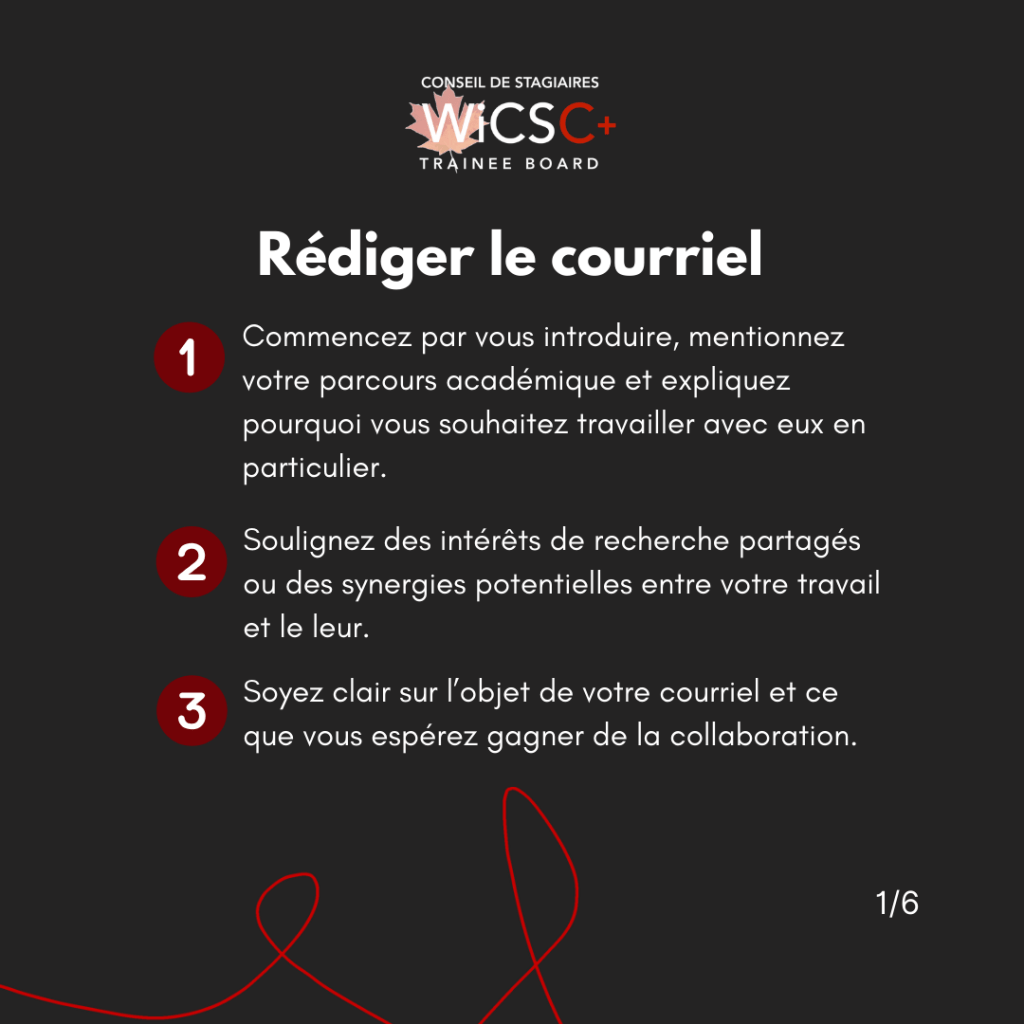
Rédiger le courriel
- Commencez par vous introduire, mentionnez votre parcours académique et expliquez pourquoi vous souhaitez travailler avec eux en particulier.
- Soulignez des intérêts de recherche partagés ou des synergies potentielles entre votre travail et le leur.
- Soyez clair sur l’objet de votre courriel et ce que vous espérez gagner de la collaboration
Proposition
- Si vous avez un projet potentiel ou des idées initiales pour votre visite, incluez-les dans votre courriel
- Soyez flexible et ouvert aux suggestions. Certains superviseurs peuvent avoir des données que vous pouvez utiliser pour votre proposition de recherche !
Exigences de votre superviseur
- Il se peut que votre superviseur d’accueil ne connaisse pas bien le programme SEEMS. Assurez-vous d’inclure des informations sur le soutien dont vous avez besoin de sa part lors du processus de demande (par ex. Une lettre de recommandation soulignant l’importance, la faisabilité et le mérite des activités proposées).
- Vous pourriez également avoir besoin de leur aide pour vous inscrire en tant que chercheur invité dans votre établissement d’accueil
.(par ex. Le visa J1 et le DS 2019 sont initiés par l’établissement d’accueil).
Demander une réunion
- Demandez-lui poliment s’il est disposé à vous rencontrer pour discuter davantage de votre collaboration potentielle.
Une fois que vous avez établi une relation claire et compréhensive avec un chercheur principal qui vous intéresse et que vous avez confirmé par écrit (par ex. par courriel) qu’il est prêt et apte à soutenir votre séjour, vous pouvez commencer la procédure de candidature.
 WiCSC
WiCSC 