





Contributors:
- Writer: Megan Kelly, Fraulein Retanal
- Editor: Madeline Wood Alexander
Part 4: Key Considerations
If you have established when and where you are going, congratulations on your opportunity to gain new research experience abroad! Keep in mind that 2-6 months is not a terribly long amount of time. It can feel nice to be able to hit the ground running but there will likely be a number of administrative challenges upon your arrival. You will have a few things to take care of beforehand to properly prepare for your study term and ensure a smooth experience.
Below, we’ve outlined key considerations to address before your departure, during your stay, and upon your return to your home institution.
Before You Leave
Timeline and logistics
- When do you need to graduate?
- Remember, the trip must start no earlier than the competition deadline date; must be during your active CGS funding time; must be taken up within ONE YEAR of receiving the notice of CGS-MSFSS award; you MUST return to complete your degree at your home institution in Canada.
- Notification of results is within ~2 months within receipt of application by NSERC (based on their agency deadlines) – note that your institution may follow earlier internal deadlines.
Exit from home institution
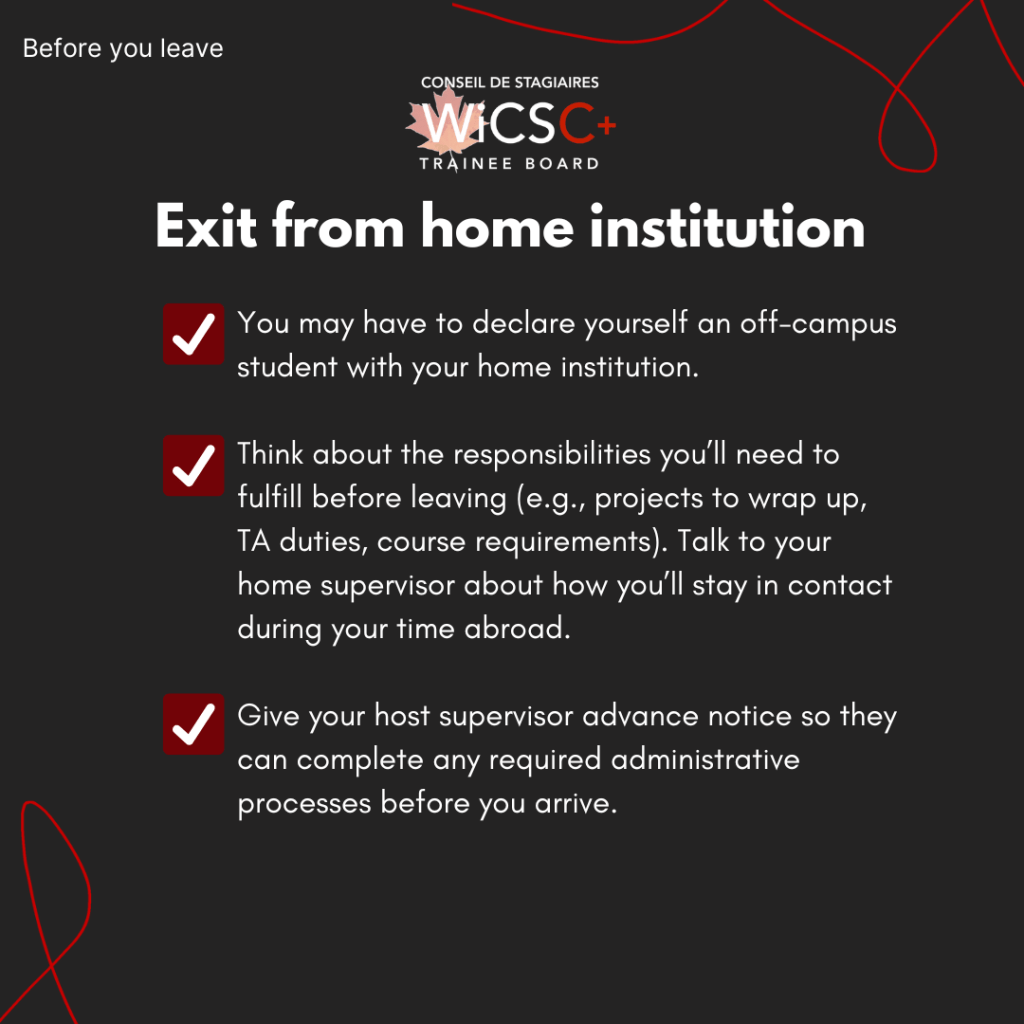
- You may have to declare yourself an off-campus student.
- What projects need to be wrapped up before your term abroad?
- What contact will you have with your home lab and supervisor whilst away?
- Give your host supervisor as much notice as possible to take care of various administrative processes within their department. For example, you may need an office space, need to be issued keys or an ID badge, etc.
- Think about what responsibilities you can and cannot put off until your return (e.g., TA duties, course requirements, etc.)
Visas and legal visiting considerations
Your host institution should have contacts available (e.g., International Student Services or similar office) that your host supervisor can point you towards for support in completing required paperwork (most institutions admit many international students and visitors, thus, established procedures are in place).
For a Canadian student going to USA, you will require:
- J1 Visa, DS2019 certificate, and SEVIS fee
- Citizens of Canada are not required to obtain a visa to enter the U.S. in the J-1/J-2 category. Thus, students visiting the USA will only need a DS2019 certificate and to pay the SEVIS fee. However, this rule does not apply to permanent residents, or “landed immigrant”, of Canada. Be sure to check the process for obtaining a J1 visa, as it may vary depending on your citizenship status.
- To issue you a DS2019 certificate, the host institution will likely ask for proof that you have funding of some capacity so that you will not require any payment from the host institution or government of the host country.
- This could be a letter outlining your funding from your home institution (or home government) and duration of tenure at the host institution that has been signed by your department’s chair of graduate studies (or similar).
- The Form DS-2019
- I-901 SEVIS Fee
- Remember to bring the DS2019 to the US Customs and Border Protection agent upon your departure for the study term. It is as important as your passport!
- Two-year home-country physical presence requirement
- If your visiting term is funded by MSFSS, you are likely subject to the two-year home-country physical presence requirement. This means that after the conclusion of your short-term study term, you must return to your home country for two cumulative years minimum prior to changing or adjusting your visa status and prior to being able to receive certain other visas (e.g., immigrant, short term worker, etc.); recreational travel to the USA is permitted during these two years.
- Consult government resources for more information, for example:
- 12- and 24-month bars on research participation (distinct from the home-country physical presence requirement above) and specific to J-1 visa holders depending on length of term (6 months or less vs. more than 6 months) and assigned category (Research Scholar/Professor)
- Most institutions have further information on this as it’s specific to the Research Scholar and Professor classifications—but not the short-term scholar classification)
- 12 and 24-Month Bars for J-1 Scholars
- Two-Year Home Residence Requirements
- 12-Month and 24-Month Bars
Finances
It can be helpful to stay organized about your expenses, planning in advance where appropriate.
Common expenses:
- Housing
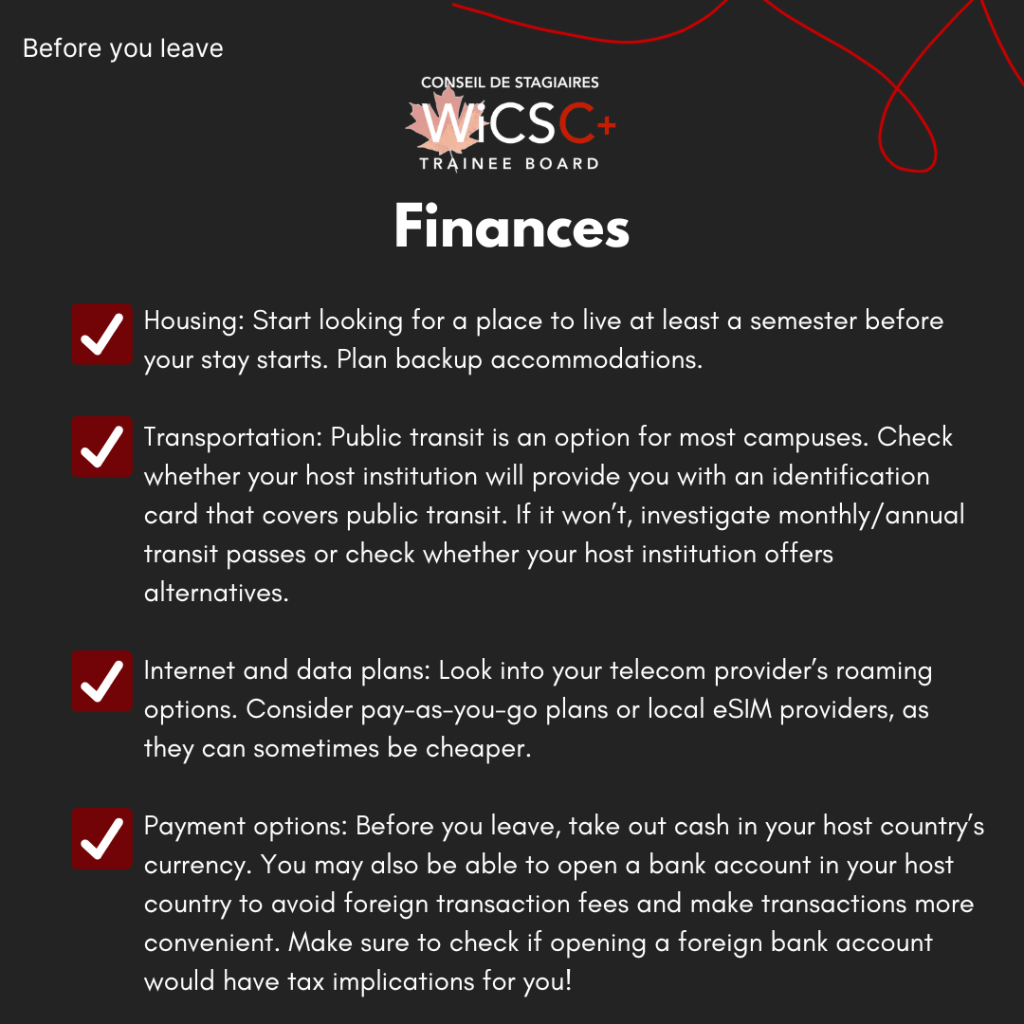
- This will likely be your largest expense and one of the most critical things to get sorted out before you leave for your study term.
- Talk to your host supervisor or the host lab members for advice on the best way to seek housing and other residence options (e.g., short-term stay options on campus, graduate student housing options, off-campus options, etc.)
- Start this process EARLY (at least one full semester before your intended start date)!
- Plan back-up accommodations:
- Short-term Airbnb stay
- Subletting from local students
- Travel/transportation
- Public transit can be a reasonable mode of transportation for most campuses, but this can vary widely depending on the geographical location of your host institution.
- Depending on the host institution, you may not be offered an identification card with transportation included.
- Monthly or annual passes for the public transit system could be useful options.
- See if your host institution can provide insight. For example, some institutions offer free university operated transportation/shuttles (e.g., uChicago shuttle) or ride app discounts to their students.
- Internet and data plans
- Talk to your provider about your options for out-of-country travel.
- Consider local pay-as-you-go or local e-sims options (e.g., Mint Mobile for USA) which may be cheaper depending on your use habits.
- Try to take out cash ahead of time in your home country’s currency.
- Canada has an exceptionally harmonized card-payment system compared to some other places, including the USA.
- There will likely be things you may need cash for (e.g., deposits for keys, various services like laundry, emergencies, etc.)
- Be aware of foreign transaction fees and exchange rates!
- While using your Canadian credit or debit card is convenient, many of them impose foreign transaction fees of up to 3% of each transaction. Consider Canadian banking cards which waive this fee.
- Banks often offer unfavorable exchange rates, so it’s good to shop around for “mid-market rates” and plan currency exchanges in advance to capitalize on favorable rates. You can check out apps like WISE to convert your money electronically which is often cheaper (*accurate as of April 2024)
- Canada has an exceptionally harmonized card-payment system compared to some other places, including the USA.
- Opening a bank account in your host country
- If you would like to avoid the variable exchange rates or incurring foreign transaction fees when using your Canadian card, you may consider whether you are able to open a bank account in your host country as an international student!
- Having a bank account in your host country can also make it more convenient when paying your rent (e.g., subletting payments are often arranged through Venmo and Zelle in USA) or when accessing certain local/online services that may require a local bank account.
- However, opening a foreign bank account may have tax implications. Be sure to thoroughly research these potential implications before proceeding!
- As alluded to earlier, if you are a Canadian citizen going to the USA, you will likely have to pay a SEVIS fee via the USA embassy.
Funding
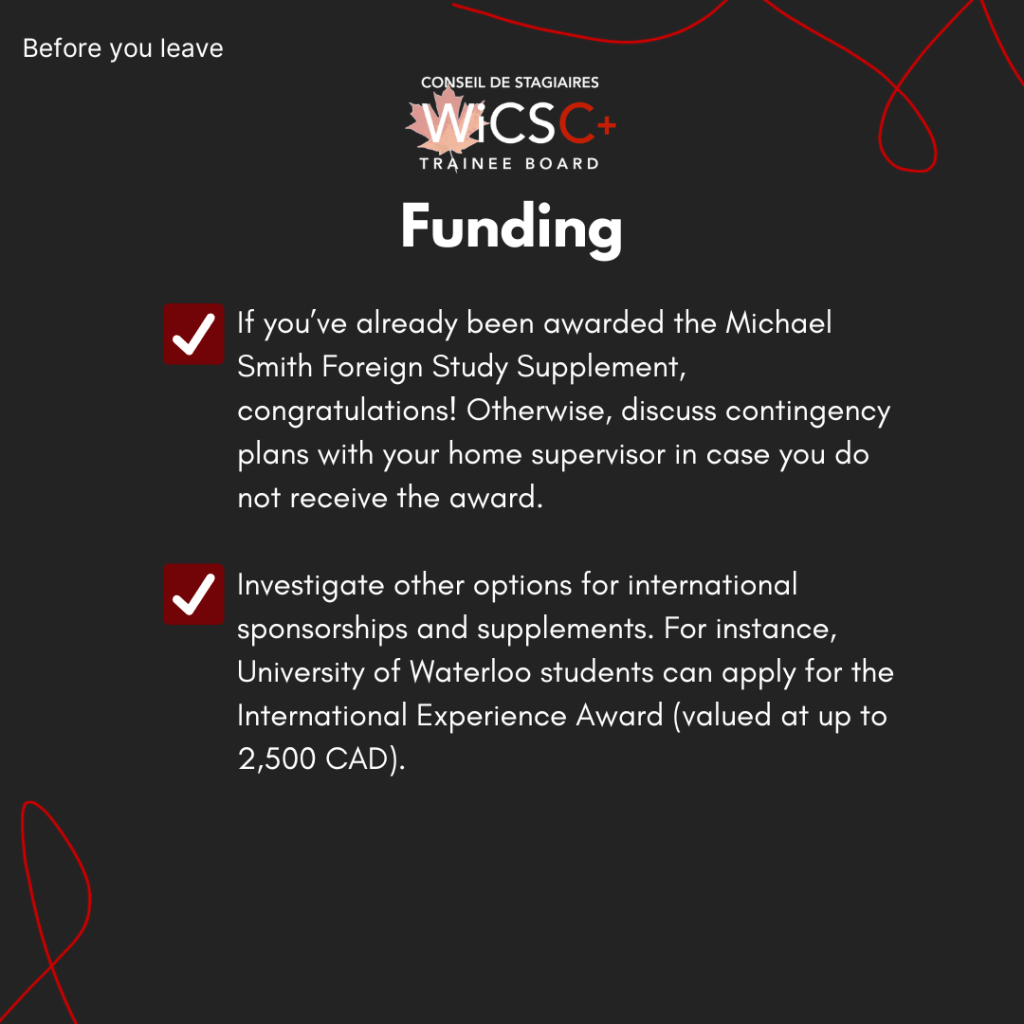
- Talk to your home supervisor about contingency plans (if applicable) in the event that you apply but do not secure the MSFSS award. – this should be one of the first things that you discuss with your home supervisor to relieve any ambiguity given the uncertainty of the situation.
- If you have already been awarded the Michael Smith Foreign Study Supplement, congratulations!
- Check for other international scholarships and supplement opportunities that you can apply for. For example, at the University of Waterloo, there is the International Experience Award which can provide up to CAD $2,500.
Insurance
- Contact your home institution about insurance coverage for students studying abroad, including health insurance.
- Depending on the host institution, you may be required to get specific insurance coverage (e.g., coverage for medical evacuation and repatriation expenses) as a visiting student. Consult a trusted source (e.g., host institution’s office for international students, an advisor, a family member, or a friend with experience, or even a reputable internet source) regarding the arrangement of additional coverage if you think it is needed.
During Your Stay
Research Project
Remember, collaboration is a dynamic process, and being flexible, communicative, and adaptive will help you navigate any challenges that arise along the way.
- Communication is key!
- Maintain regular communication with your host supervisor. Keep them updated on your progress, challenges, and any changes in your plans.
- Similarly, be open to receiving feedback and guidance from them.
- This will help prevent misunderstandings down the line and ensure that both you and your host supervisor are on the same page from the get-go.
- As your collaboration progresses, take time to reflect on what is working well and what could be improved. Be willing to adapt and make adjustments as needed to ensure the success of the project.
- Do your best to have realistic expectations!
- The length of time of your visit is not very long and the first little while (up to the first month or more) will likely require many administrative tasks or tasks relating to the set-up of your new living situation.
- Similarly, the last couple weeks of your visit may require similar tasks to ensure you can return home with little hassle. Do your best to reach the goals decided by both you and your host supervisor while being kind to yourself about any realistic constraints you may be facing that you may not normally deal with in your home lab/country.
Environment and culture
Take Advantage of Resources and Training Opportunities!
- Research
- Find out
- Materials and resources available at the host institution or within the host lab
- Culture surrounding research practices or statistical analyses that you may need to adapt to.
- Compatibility with your personal orientation regarding industry and academic opportunities
- Find out
- Learning
- Audit courses (though, not too many, because research is your top priority)
- Get to learn the talents and skills of your host lab members and the host department.
- Likewise, don’t hesitate to share your own expertise and insights with your host lab!
- Social/personal
- How will you or will you need to balance your social commitments from home while you’re away?
- What does the day-to-day life of a student at your host institution look like compared to what you are used to?
- What are some social activities available for students at your host institution?
- As a visiting scholar you may be eligible for student perks and amenities such as student discounts at museums or access to campus events, sports facilities, or cultural outings!
- Your host institution likely has an international office or orientation resources that can give you more information about these available social resources!
Networking
- What sort of informal or formal opportunities are there for socializing, connecting, and networking?
- There are likely other faculty (and other students) that you can get to know and learn from during this time, for example, you can attend the lab meetings of other faculty or ask to go for coffee with people that interest you!
- While you’re down there, you can likely take the time to explore other potential networking opportunities.
Returning to Your Home Institution
Return to home institution
An agreement within the Michael Smith award guide is that you return to your home institution to complete your studies.
- Exit Requirements
- Within two months of completing your research study period abroad, you must submit an activity report to the agency! For more information, check out the award holder guide here.
- Research
- How much time are you leaving to continue your studies after your term has completed?
- What sort of collaborations might you be continuing after your return?
- Do your best to ensure that you, your host supervisor, and your home supervisor are all on the same page going forward. This includes expectations and opportunities for continued collaboration after your formal visit has concluded.
- This can affect your workload so be open with your supervisor(s) about this if possible.
- Social/Personal
- Don’t forget to express gratitude to your host supervisor and the network you’ve cultivated during your visit!
- Staying in contact with your host supervisor and the network you’ve built during your visit can prove invaluable for future collaborations, research opportunities, and professional connections. Expressing gratitude and keeping these lines of communication open can foster long-term relationships that extend beyond your time abroad.
- However, it’s important to acknowledge that not every relationship will flourish indefinitely. If your experience with your host supervisor or network doesn’t align as expected, it’s completely okay. Not every connection will result in ongoing collaboration, and it’s valuable to learn to recognize when a partnership may not be the best fit. Learning from these experiences is just as important as nurturing successful connections
Snapshot Timeline
Note that this is just for organizational purposes and your individual situation may require additional or alternative considerations than those listed here. As with the other information provided earlier, this is meant to be a helpful guide for those who may not be sure where to start.
| Approximate Time Point | Considerations checklist |
|---|---|
| 8-12 mo. + before intended visiting term starts | o Consider the best timing for your visiting term. o Consider your budget and where you can afford to visit based on their local economy, your financial support, etc. o The MSFSS, while wonderful to be granted, is unlikely to cover the full cost of your visiting study term. o Contact your top two or three prospective PIs about potential opportunities for you to be a visiting graduate student in their labs. o Decide which PI you would most like to visit given potential funding from the MSFSS o Make sure your travel documents are all valid and up-to-date! Getting this arranged could take up to 6 months in some cases. o Draft research proposals or study plans that fit with the research program of your prospective host supervisor. o Remember to let your potential host supervisors know of any important plans you might already have arranged during your visiting term (e.g., conferences, weddings, etc.) |
| ~6 mo. + before semester of visiting term starts | o Finalize the research proposal or study plan for your visiting term with your prospective host supervisor and home supervisor o Apply for the MSFSS at least four months before your visiting term is set to start! o Make sure that you, your home supervisor, and your host supervisor are all on the same page about what happens if you do not secure the funding (e.g., postpone the visit, try applying again the following term, or go anyways without external funding if that is feasible for both home and host supervisors). o Keep your host supervisor updated on anything relevant to them (e.g., that they will need to provide a letter attesting that they agree to host your visit). o Research and, if possible, try to arrange housing/accommodations ASAP! Having this organized will be a huge relief so do not procrastinate it! o Look into travel-related costs both to your host institution and back to your home institution in addition to any transportation you may require during your visit. o If applicable, apply to any other relevant funding opportunities (e.g., awards, bursaries) from your home institution dedicated to providing support to students planning to undertake international or collaborative experiences. o Initiate any relevant visa application processes or other travel requirements. |
| 1 semester before the visiting term starts | o Confirm that your host supervisor, your home supervisor, and you are still all on the same page about the plan and any relevant contingencies o Hopefully you know by now or will know soon whether you have been awarded the MSFSS, and where you will be living during your visiting term o Depending on the style of your host supervisor, you may already start administrative processes, such as requesting office space, ethics clearance for any projects you might already be planned to partake in, etc. o Scout flights and transportation to your arranged accommodations o Double check that your visa or visitor status is as it should be or make any necessary arrangements to ensure it will be by the time you need to clear customs o Arrange phone and internet plans if applicable so that you have connections when arriving o If any friends or family are interested in visiting you, scope out the appropriateness and potential timing for this with your host supervisor o Look into whether you’d like to audit any courses at the host institution and clear this with both your host supervisor and the course instructor after considering your schedule o Check with your home institution whether this upcoming visiting term can count for any type of research practicum course or credit, if so, be sure to enroll come the add period if applicable o Check with your home institution whether you need to declare a different student status (e.g., “off campus, full time”, etc.) |
| 1 mo. before the visiting term starts | o Have all your paperwork required and ready for your trip o Make sure you understand the local weather if going to an unfamiliar region so that you can have any necessary clothing, accessories, etc. that are standard (if applicable) o Book flights and transportation to your arranged accommodations if you have not already o Confirm accommodations and key pickup arrangements (if not already done) o Familiarize self with local area, transportation options, etc., such as reviewing the layout of campus or institution, buildings of interest to your work (i.e., where your office is) compared to your accommodations, grocery stores, other points of interest, etc. o Plan out what you will need once you arrive. You will likely be starting a little bit from scratch and thus, may need to buy kitchen items, cleaning supplies, laundry supplies, etc. during your first few days of arrival. If you don’t have access to a car, it may take many trips via public transportation for things that aren’t easily delivered so plan accordingly. |
| 1 wk. before semester of visiting term | o Ensure all your documents (e.g., passport, visa/equivalent) are packed or ready to pack. o Pack!! This is not a few weeks, this is likely a few months and, therefore, packing for this trip might take more time and consideration (especially if there will be seasonal changes) o Set up or configure any relevant apps or accounts such as Uber, Amazon, etc. depending on the services you’re used to having at home and would like during your visiting term o You’ll likely want to present your research to the department you are visiting. Make those arrangements and start working on your talk early so you are prepared and not blind-sighted by a short-notice invitation! |
| First week of visiting term | o Meet with your host supervisor and lab o Attend any relevant orientation sessions offered by the host institution o Connect with fellow students and explore any social opportunities o Explore campus and important/relevant facilities (e.g., library, bookstore, services for international visiting students) |
| 1 wk. into the visiting term | o Establish a routine that works for both you and your host supervisor and host lab o Get to know the local community and any relevant social activities or opportunities of interest (both on and off campus) o Be prepared that this first week might be particularly difficult given the transition and lack of social support compared to what you might have established back at home. Reach out to loved ones or support networks as needed. |
| 1 mo. into the visiting term | o Check in with your host supervisor about progress or any recommended changes. o Continue adjusting to your new day-to-day life. |
| During the visiting term | o Attend relevant department events (e.g., area brown bags, colloquia, networking events, etc.) o Socialize with the students and faculty o Attend the meetings of other labs if it interests you and is approved by your host supervisor! o Do whatever you feel like that helps you make the most of your experience (including for your recreation!) |
| 1 mo. before end of visiting term | o Plan for the conclusion of your visiting term (e.g., procedures for moving out of your accommodations, ending your visiting status) o Review any final goals for you and your host supervisor o Figure out proper storage for any research materials (e.g., signed consent forms, tracking sheets or any other physical documents) if it is not appropriate or possible to take back home. o Begin packing for your trip back home. It can be overwhelming to leave this too late depending on how quickly you must be out of your accommodations according to your lease and when you are legally to return home o Start arranging for anything at home that needs to be ready upon your arrival |
| Final week of visiting term | o Decide on what to do with any incomplete or ongoing projects after your term ends (e.g., will they be passed on to another student, will you take them back with you to lead and collaborate from your home institution, etc.) o Return any keys or equipment allocated to you during your visit (e.g., lab keys, materials, etc.) o Say your goodbyes o Express gratitude to host supervisor, colleagues and anyone who helped make your experience smoother and/or more enjoyable |
| After visiting term ends | o Return to complete PhD at home institution (this is a condition within the award holder’s guide for the Michael Smith Foreign Study Supplement) o Keep your host supervisor updated on any ongoing collaborations and opportunities for their dissemination (e.g., at conferences, in your home department, manuscript, etc.) o Submit any requested final reports or documents as required by your home institution or funding. o Update your resume or CV with any relevant experiences gained from this study term. o If you were a Canadian in the USA, you may be requested to fill out and mail back tax-related forms even though you did not receive income from the US federal government, relevant instructions will be provided to you at the time accordingly. o https://www.irs.gov/individuals/international-taxpayers/substantial-presence-test |









Contributrice :
- Écrivaine : Megan Kelly, Fraulein Retanal
- Révision: Madeline Wood Alexander
Si vous avez décidé où et quand vous voyagerez, félicitations pour cette opportunité d’acquérir de l’expérience de recherche à l’étranger!
N’oubliez pas que la durée du voyage – 2 à 6 mois – sera assez courte. Dans ce billet, nous soulignerons certaines choses importantes à prendre en compte avant, durant et après votre séjour.
Avant de partir
- Calendrier/logistique
- N’oubliez pas votre date limite pour graduer lorsque vous planifiez votre voyage.
- N’oubliez pas que votre voyage doit commencer après la date limite du concours, qu’il doit avoir lieu durant votre période de financement par le Programme de bourses d’études supérieures du Canada et que vous devez revenir compléter vos études dans votre institution d’origine.
- Vous recevrez une décision dans les deux mois suivants la réception de votre demande par le CRSNG. Vous devrez commencer votre voyage dans l’année qui suit votre réception de l’avis d’octroi.
- Départ de votre institution d’origine
- Vous aurez peut-être à vous déclarer comme étudiant·e hors-campus auprès de votre institution d’origine.
- Songez aux responsabilités que vous aurez à assumer avant votre départ (par exemple, des projets, des tâches d’assistanat d’enseignement ou des travaux pédagogiques à compléter). Arrangez-vous pour rester en contact avec votre superviseur·e d’origine durant votre séjour.
- Avisez d’avance votre superviseur·e d’accueil pour que cette personne puisse effectuer les démarches administratives requises avant votre arrivée.
- Questions légales et en lien au visa
- Certaines institutions d’accueil offrent des services pour vous aider à compléter les documents requis avant votre arrivée.
- Si vous êtes canadien·ne et que votre séjour aura lieu aux États-Unis, vous devrez obtenir un certificat DS2019 et payer un frais SEVIS. Il vous faudra présenter votre certificat DS2019 à la frontière; il est aussi important que votre passeport. De plus, vous pourriez être soumis·e à une obligation de présence physique de deux ans à votre retour à la maison. Si vous n’avez pas la citoyenneté canadienne, vous pourriez avoir à obtenir un visa J1 et à vous soumettre à une interdiction de participer à la recherche pour 12 ou 24 mois.
- Aspects financiers
- Il peut être avantageux de planifier vos dépenses avant votre départ.
- Logement : Commencez votre recherche de logement au moins un semestre avant votre séjour. Ayez un plan B au cas où vous ne trouveriez rien.
- Transport : Le transport en commun est une option sur la majorité des campus. Vérifiez si votre institution d’accueil vous fournira une carte d’identification qui couvre les coûts du transport en commun ou si elle offre d’autres options similaires. Sinon, les laissez-passer mensuels/annuels peuvent être intéressants.
- Plans de télécommunication : Faites des recherches sur les options qu’offre votre fournisseur de services de télécommunication pour les séjours à l’étranger. Comparez ces options aux plans tarifés à l’usage ou offerts par les fournisseurs eSIM à votre destination, car ceux-ci peuvent parfois coûter moins cher.
- Modes de paiement : Avant votre départ, sortez de l’argent dans la devise de votre pays d’accueil. Dans certains cas, il peut être possible d’ouvrir un compte de banque dans votre pays d’accueil. Cela peut vous aider à éviter les frais de transaction en monnaie étrangère et simplifier les transactions quotidiennes. Toutefois, vérifiez si l’ouverture d’un tel compte aurait des conséquences fiscales pour vous.
- Financement
- Si on vous a octroyé le supplément Michael-Smith, félicitations! Sinon, discutez avec votre superviseur pour savoir s’il y a d’autres options.
- Effectuez des recherches quant aux autres bourses et suppléments pour les études à l’étranger. Par exemple, les étudiants à l’Université de Waterloo peuvent postuler pour l’International Experience Award (d’une valeur allant jusqu’à 2500$ CAN).
- Assurances
- Contactez votre institution d’origine pour savoir si elle offre des polices d’assurance (par exemple, l’assurance santé) pour les études à l’étranger.
- Votre institution d’accueil pourrait avoir des exigences en lien à l’assurance pour les étudiants en visite.
Durant votre séjour
- Projet de recherche
- La communication est essentielle pour éviter les malentendus! Restez en contact avec votre superviseur·e d’origine et faites preuve d’ouverture d’esprit quant à ses commentaires et ses suggestions.
- Tout au long de votre collaboration, pensez à ce qui fonctionne bien et à ce qui pourrait être amélioré. Faites preuve d’adaptabilité!
- Soyez réaliste avec vos attentes! Votre séjour ne durera pas très longtemps. De plus, vous aurez beaucoup de tâches administratives à accomplir à votre arrivée et à votre départ.
- Faites votre possible pour atteindre les objectifs de recherche que vous avez fixés avec votre superviseur·e d’accueil. Cependant, soyez bienveillant·e envers vous-même si les contraintes du séjour limitent ce que vous parvenez à accomplir.
- Culture et environnement
- Informez-vous quant aux ressources de recherche offertes par votre institution d’accueil. Renseignez-vous sur sa culture en lien à la recherche et aux analyses statistiques.
- Tirez parti des opportunités d’apprentissage qui s’offrent à vous! Vous pourriez en apprendre beaucoup grâce à l’expertise des gens de votre laboratoire d’accueil, et eux, grâce à la vôtre. Si votre institution d’accueil offre des cours qui vous intéressent, vérifiez si vous pourriez y assister.
- Informez-vous pour savoir si votre institution d’accueil offre des activités sociales qui pourraient vous intéresser!
- Réseautage
- Des opportunités de réseautage – officielles et moins officielles – s’offriront probablement à vous durant votre séjour. Apprenez à connaitre la communauté de votre institution d’accueil!
Retour à votre institution d’origine
- Tâches à compléter à votre retour
- Vous aurez à présenter un rapport d’activités à l’agence de financement dans les deux mois suivant la fin de votre séjour.
- Recherche
- Poursuivrez-vous certaines collaborations après votre retour à la maison? Assurez-vous d’être en accord avec vos superviseur·e·s d’accueil et d’origine quant aux opportunités et aux attentes à ce sujet.
- Aspects sociaux et personnels
- N’oubliez pas de faire preuve de gratitude envers votre superviseur·e d’accueil et envers les personnes avec qui vous avez tissé des liens durant votre séjour! Rester en contact avec votre superviseur·e d’accueil peut ouvrir des portes pour d’autres collaborations et opportunités.
- Toutefois, certaines connections ne sont pas faites pour durer indéfiniment. Ne vous en voulez pas si votre expérience de séjour n’a pas été conforme à vos attentes. Il y a bien des apprentissages à tirer de telles expériences!
 WiCSC
WiCSC 