Preparing for
Academic Careers
Posts
Tips for a professional headshot
Contributor/Contributeur: Sarah BlackburnEditing/Révision: Fraulein RetanalVisuals/Visuels : Taeko BourqueTranslation/Traduction : Taeko Bourque Pour la traduction en française, cliquez-ici What is a professional headshot and why do I need one? A professional headshot is a high-quality portrait photograph, often taken by a professional photographer, that captures your face in a polished and confident way. These headshots are…
Neurodiversity in Grad School (Part 2) – Accommodations
Contributors: Recap: ‘Neurodiverse’ is a term used to describe the range of neurotypes (essentially your brain or ‘wiring’) – this includes neurodivergent (ND) and neurotypical (NT) people. Different forms of neurodivergence (e.g., Autism, ADHD, OCD, Dyslexia, Dyscalculia, etc.) may present differently and require different levels and types of support. **No two individuals are completely alike,…
Canada Graduate Scholarship – Michael Smith Foreign Study Supplement (Part 4)
Contributors: Part 4: Key Considerations If you have established when and where you are going, congratulations on your opportunity to gain new research experience abroad! Keep in mind that 2-6 months is not a terribly long amount of time. It can feel nice to be able to hit the ground running but there will likely…
Canada Graduate Scholarship – Michael Smith Foreign Study Supplement (Part 3)
Contributors: Official information from NSERC regarding the supplement and application procedures is available at: https://www.nserc-crsng.gc.ca/Students-Etudiants/PG-CS/CGSForeignStudy-BESCEtudeEtranger_eng.asp Award holder’s guide by NSERC: https://www.nserc-crsng.gc.ca/Students-Etudiants/Guides-Guides/CGSMSFSSRegs-BESCSEEMSRegs_eng.asp NSERC Email: schol@nserc-crsng.gc.ca CIHR Email: CGSMSFSS-SEEMSBESC@cihr-irsc.gc.ca SSHRC Email: fellowships@sshrc-crsh.gc.ca The following article is not intended as a substitute for official NSERC or Tri-agency documentation regarding the MSFSS. Instead, it is meant to be a…
Canada Graduate Scholarship – Michael Smith Foreign Study Supplement (Part 2)
Contributors: Official information from NSERC regarding the supplement and application procedures is available at: https://www.nserc-crsng.gc.ca/Students-Etudiants/PG-CS/CGSForeignStudy-BESCEtudeEtranger_eng.asp Award holder’s guide by NSERC: https://www.nserc-crsng.gc.ca/Students-Etudiants/Guides-Guides/CGSMSFSSRegs-BESCSEEMSRegs_eng.asp NSERC Email: schol@nserc-crsng.gc.ca CIHR Email: CGSMSFSS-SEEMSBESC@cihr-irsc.gc.ca SSHRC Email: fellowships@sshrc-crsh.gc.ca The following article is not intended as a substitute for official NSERC or Tri-agency documentation regarding the MSFSS. Instead, it is meant to be a…
Canada Graduate Scholarship – Michael Smith Foreign Study Supplement (Part 1)
Canada Graduate Scholarship – Michael Smith Foreign Study Supplement (CGS-MSFSS; 2-6 months, up to CAD $6000) Contributors: Official information from NSERC regarding the supplement and application procedures is available at: https://www.nserc-crsng.gc.ca/Students-Etudiants/PG-CS/CGSForeignStudy-BESCEtudeEtranger_eng.asp Award holder’s guide by NSERC: https://www.nserc-crsng.gc.ca/Students-Etudiants/Guides-Guides/CGSMSFSSRegs-BESCSEEMSRegs_eng.asp NSERC Email: schol@nserc-crsng.gc.ca CIHR Email: CGSMSFSS-SEEMSBESC@cihr-irsc.gc.ca SSHRC Email: fellowships@sshrc-crsh.gc.ca The following article is not intended as a substitute…
How to Write a Literature Review
Pour la traduction en française, cliquez-ici Contributors: What is a Literature Review? Literature reviews survey research done in a particular area or topic in Psychology. Research articles are empirical articles specifically describing one or a few related studies. The purpose of a literature review is (1) to thoroughly describe and compare studies done in a…
Statement of Purpose
Pour la traduction en française, cliquez-ici Contributors: Most, if not all, academic programs and careers require you to submit your CV and statement of purpose (SOP). In this blog post, we will cover some information and tips on how you can make your application stand out by creating a Statement of Purpose. The Statement of…

Supporting Trans Students
Contributor/Contributeur: Vegas HodginsEditing/Révision: Fraulein Retanal, Veronic Lynn Delage, Diya KamineniVisuals/Visuels : Tamanna IslamTranslation/Traduction : Yasmine Bachkhaznadji Pour la traduction en française, cliquez-ici In this time of increased discrimination against the trans community, the forward progress in trans rights that we have begun to grasp over the past decade seems to be unravelling in our hands.…
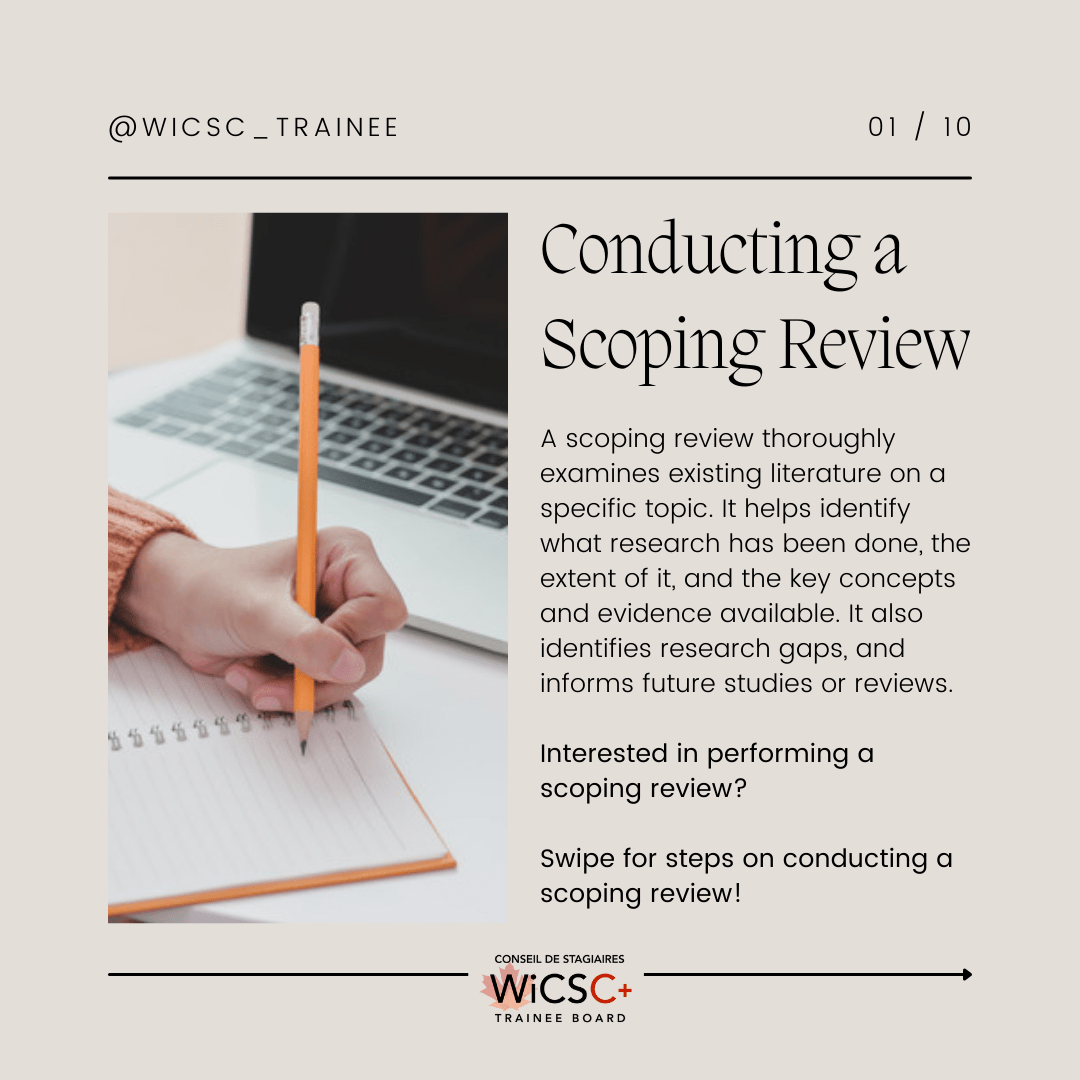
Conducting a Scoping Review
Contributor/Contributeur: Andie Storozuk (Guest/invité)Editing/Révision: Madeline Wood Alexander, Fraulein RetanalVisuals/Visuels : Julianna SalvatierraTranslation/Traduction : Elena Bakker Pour la traduction en française, cliquez-ici What is a scoping review? A scoping review is a comprehensive analysis of existing literature on a specific topic. It aims to identify what research has been done, how extensive it is, and the…
Academic CV
Contributor/Collaborateur: Sabrina Shajeen AlamEditor/Révision: Vivian Liu, Fraulein Retanal, Madeline Wood AlexanderVisuals/Visuels: Julianna SalvatierraTranslator/Traducteur: Yasmine Pour la traduction en française, cliquez-ici Most, if not all, academic programs and careers require you to submit your CV and statement of purpose (SOP). In this blog post, we will cover some information and tips on how you can make…

How to Ask for a Reference Letter
Contributor/Collaborateur: Vegas HodginsEditor/Révision: Madeline Wood AlexanderVisuals/Visuels: Fraulein RetanalTranslator/Traducteur: Elena Bakker Pour la traduction en française, cliquez-ici Introduction So, it’s that time of year again. The time in every academic career when you need to draw on your connections to prove that you aren’t the only person who thinks you’re great. Reference letters are an important…
Tips to Consider When You Apply for A Postdoctoral Position
Contributor/Collaborateur: Sabrina Shajeen Alam & Qiushan LiuEditor/Révision: Vivian Liu, Fraulein Retanal, Madeline Wood AlexanderTranslator/Traducteur: Taeko Bourque Pour la traduction en française, cliquez-ici Preparing yourself for a postdoctoral application can be stressful and nerve-wracking. As an advanced PhD candidate/a new full-fledged PhD, you are well-aware that it is fiercely competitive. So, a smart way could be…
The Non-Early Career Researcher Gender Gap in NSERC CogSci Funding
Contributor/Collaborateur:Vegas HodginsEditor/Révision: Debra TitoneVisuals/Visuels: Fraulein Retanal We often speak about the gender gap in STEM, but how can we quantify this difference? One method is to look at the number and monetary value of grants awarded at the undergraduate, graduate, postdoctoral, and faculty levels to researchers of different genders. At the 2023 annual meeting of…
Preregistration in Psychological Research
Contributor/Collaborateur: Elora Wales, Megan Kelly, and Sophia Tran Veuillez noter que le guide est disponible uniquement en anglais. What is Preregistration? Preregistration is the process of creating a plan for your study and sharing it in a public registry (e.g., the Open Science Framework) before carrying out the research. Why is Preregistration Important? Preregistration allows…
Attending Your First Conference
Contributor/Collaborateur: Elora WalesEditor/Révision: Madeline Wood AlexanderVisuals/Visuels: Elora Wales Pour la traduction en française, cliquez-ici Attending your first conference may feel a bit intimidating. Don’t worry! Here, we provide you with some indispensable tips to navigate this experience with confidence and make the most out of your first conference. DO YOUR RESEARCH BEFOREHAND TALK TO YOUR…
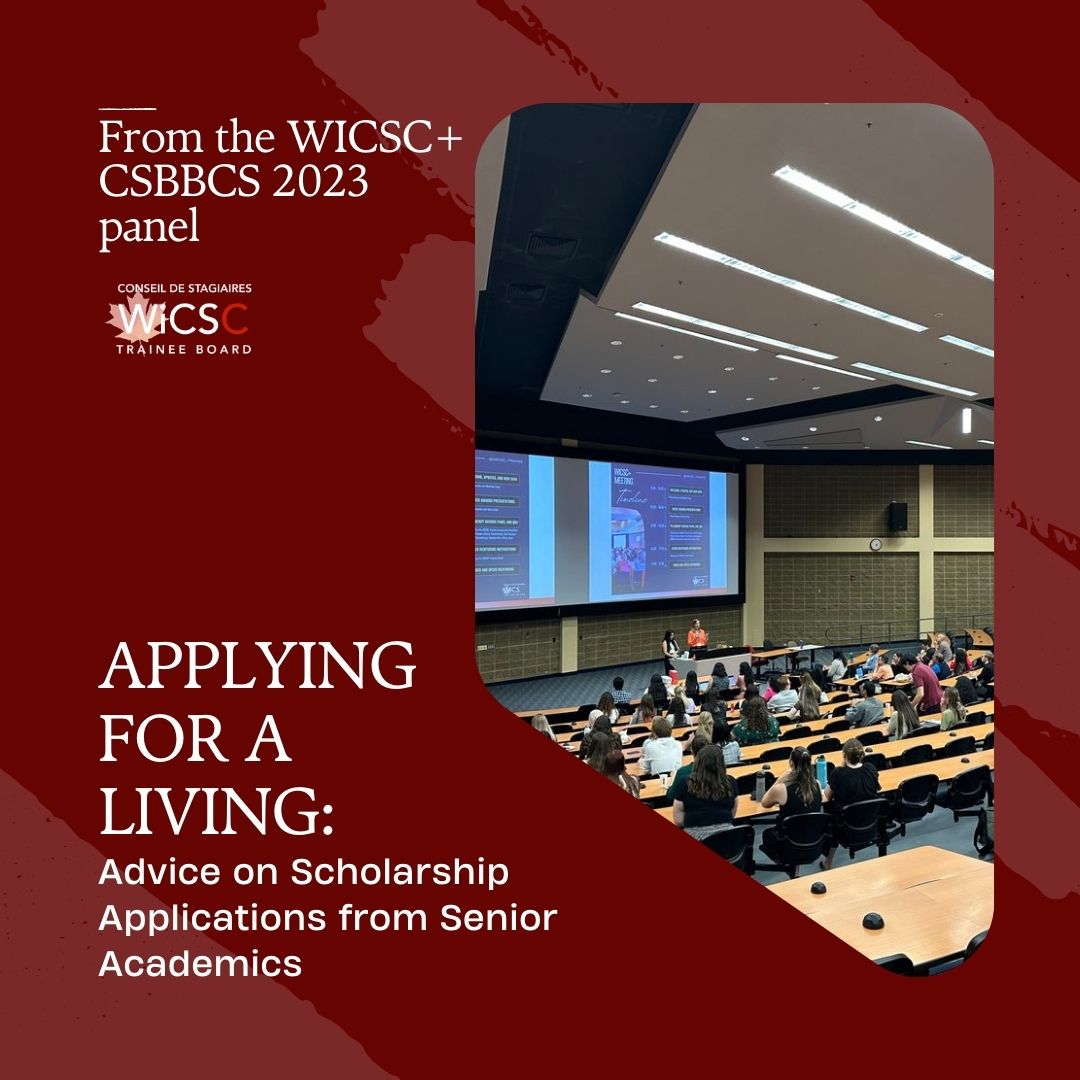
Applying for a Living: Advice on Applications from Senior Academics
Contributor/Collaborateur: Vegas Hodgins (WiCSC member) Overview Whether you’re already a graduate student or post-doctoral researcher or hopeful to become one, applications for programs, grants, and fellowships are an intrinsic part of the career cycle. Read this blog post to gain important knowledge about maximizing the potential of your applications from academics intimately familiar with the…

Supporting Neurodivergent Students Part 1: Communication
Pour la traduction française, cliquez ici ‘Neurodiverse’ is a term used to describe the diversity of neurotypes (essentially your brain or ‘wiring’) – this includes neurodivergent (ND) and neurotypical (NT) people. Different forms of neurodivergence (e.g., Autism, ADHD, OCD, Dyslexia, Dyscalculia, etc.) may present differently and require different types or levels of support. **No two…

How to Refine Your Google Scholar Experience
Pour la traduction en française, cliquez ici Google Scholar is a useful and accessible tool that allows users to conduct comprehensive searches of scholarly literature from all around the world. Google Scholar allows users to find and access scholarly literature and related literature (e.g., articles that have cited the selected article; See our post “How…
Federal and Provincial Funding Opportunities
Contributor/Collaborateur: Vivian Liu Disclaimer: The information provided in this document may not be entirely accurate or current, as it is subject to change since the time of its creation. We strongly advise you to consult the official website of each scholarship for the most accurate and up-to-date information. Pour la traduction en française, cliquez-ici As…
Something went wrong. Please refresh the page and/or try again.
 WiCSC
WiCSC 